

What Does Marketing Even Become?
Doing more used to be the answer. Now it's the obstacle

Someone downloaded an e-book in 2016. Four minutes later, their phone rang.

Not because they asked to talk to anyone. Not because they had a question. Because a scoring model decided they were “hot.” The download, combined with their job title and company size, crossed a threshold. The system did exactly what it was designed to do.
This was considered best practice. Marketing teams celebrated it.
That moment captures something important. Not about automation or efficiency. About a confusion that became so normal we stopped noticing it. Activity got mistaken for truth. A download became intent. A click became interest. A threshold became a buying signal.
AI is about to make this infinitely worse. To understand why, look at what’s already broken.
In January 2023, Chegg was a $12 billion company. Students paid monthly for homework help, study guides, textbook solutions. The model had worked for over a decade. Then ChatGPT reached 100 million users.
Dan Rosensweig, Chegg’s CEO, had navigated disruption before. He’d been at Yahoo during the Google threat. He’d helped transform Chegg from a textbook rental company into an education platform. But on an earnings call in May 2023, his voice carried something different. The decline, he told investors, was “faster than we could have ever anticipated.” By September, Chegg’s market cap had fallen to $1 billion.
Casey Winters, who led growth at Pinterest and now advises startups on surviving these transitions, put it simply: “Chegg had pivoted successfully before. With AI, it happened too fast to respond.”
Stack Overflow watched the same physics play out. Prashanth Chandrasekar, their CEO, had spent years building the world’s largest programming Q&A database. Fifteen years of developer knowledge, carefully curated, community-moderated. Traffic started falling in late 2022. By mid-2023, visits had dropped 35%. The content was still accurate. The community was still active. But developers had stopped coming because a chatbot answered faster.
These aren’t isolated cases. They’re the new pattern. Customer expectations don’t rise gradually anymore. They spike overnight, and the companies that built advantages over decades discover those advantages can evaporate in quarters.
So what happens when you apply this speed to marketing channels?
Every major acquisition channel is degrading simultaneously. This isn’t cyclical. It’s structural.
Andrew Chen documented this recently: search is flooded with AI content, paid is an auction that favors whoever can lose money longest, and social is rented land where the landlord keeps raising rent while reducing what you get. (His piece covers the evidence.)
The pattern is the same everywhere. The channels still work. The margins keep shrinking. And the companies winning are often the ones who can afford to lose money longest.
All of this lands on one desk: the CMO.
The average tenure is fourteen months. Not long enough to see a strategy succeed.
The role has become a scapegoat position. Revenue misses? Marketing didn’t generate enough pipeline. Sales cycle lengthened? Marketing brought in the wrong leads. Brand isn’t resonating? That’s marketing. Competitors outspending? Marketing should have been more efficient.
CMOs are held responsible for outcomes they can’t control in timeframes that don’t match reality. So they optimize for what can show results quickly: more campaigns, more content, more activity. The metrics improve. The dashboards look better. The underlying problems remain.
The pressure to do more becomes the obstacle to doing what works.
The Split: Execution vs. Judgment
So marketing is breaking. The channels are degrading, the role is dysfunctional, the playbook is failing. What replaces it?
The answer is emerging in a split. Marketing is dividing into two distinct layers, and they require completely different approaches.
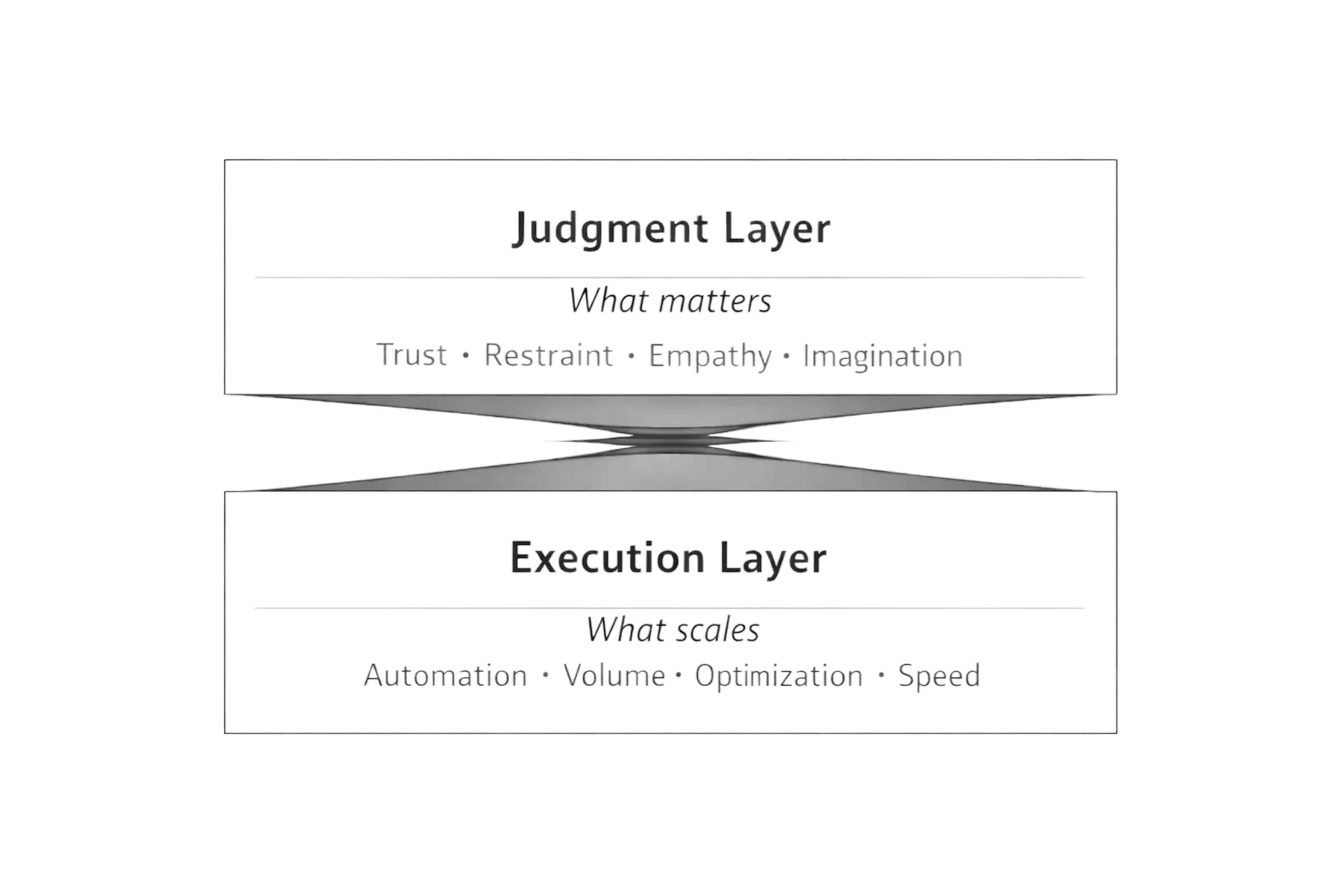
The Execution Layer
This is the work of running campaigns, producing content, optimizing channels, managing media spend, testing variations, analyzing performance. The work that fills calendars and populates dashboards.
This layer is being automated. The question is no longer whether, but how fast.
Here’s what the shift looks like in practice. A mid-sized e-commerce company tested AI-generated product descriptions against their copywriting team’s work. They ran the test quietly, not telling anyone which descriptions came from where. After 60 days and 50,000 page views per variation, the AI descriptions outperformed on conversion rate. Not by a little. By 23%.
The copywriters were good. They’d been writing for this brand for years. They understood the voice, the customer, the products. But they couldn’t compete with a system that could test hundreds of variations while they were still on the first draft.
This pattern is repeating across every execution task. Media buying. Email optimization. Ad creative testing. Landing page iteration. The humans aren’t incompetent. The machines are just faster at finding what works.
The execution layer isn’t disappearing. It’s being absorbed by systems that do it better.
The Judgment Layer
Rory Sutherland, the vice chairman of Ogilvy, tells a story about Eurostar that’s worth hearing properly.
The train company wanted to improve the London-to-Paris experience. They hired engineers. The engineers did what engineers do: they studied the problem, ran the numbers, built models. Their recommendation was to spend six billion pounds reducing the journey time by forty minutes.
Sutherland was in the room when they presented. He listened to the engineering analysis, the feasibility studies, the cost projections. Then he raised his hand.
What if, he asked, instead of spending six billion pounds to make the journey forty minutes shorter, you spent a fraction of that hiring supermodels to serve free Château Pétrus to passengers for the entire journey?
The room probably laughed. Sutherland is used to that. But he was making a point about what the engineers had missed. Passengers don’t want a shorter journey. They want to enjoy the journey. The forty minutes isn’t the problem. The experience is the problem.
No algorithm would have suggested the supermodels. The proposal required understanding something about human desire that doesn’t appear in the data. It required judgment about what people actually want, which is different from what they say they want, which is different from what the metrics measure.
This layer asks questions that execution can’t answer. Which problems are worth solving. Which customers to serve. What’s actually true about a market. When the data is misleading. Whether a strategy makes sense even when the metrics say it’s working.
The distinction matters because the same person often can’t do both well. Execution rewards speed, volume, optimization within known parameters. Judgment rewards patience, depth, willingness to question parameters entirely. These are different skills, different mindsets, different ways of working.
The middle ground, being decent at both, is where most marketing careers were built. That middle ground is eroding. Execution is being automated. Judgment is becoming more valuable precisely because execution is commoditized. But the transition is brutal for people who built careers in between.
When More Makes It Worse
Here’s where most thinking about AI in marketing goes wrong.
Everyone is asking how to use AI to do more. More content. More campaigns. More variations. More optimization. More activity.
Wrong question.
The judgment that matters now isn’t knowing what to do. It’s knowing what to stop.
When not to scale. When not to automate. When not to speak.
because AI makes activity infinite. Every instinct can now run at unlimited volume. The scoring model that called someone four minutes after an e-book download? It can now call ten thousand people simultaneously. The mediocre content that used to take a week to produce? It can publish hourly. The email sequences that annoyed customers? They can run continuously across every segment.
The sin doesn’t disappear with better technology. It metastasizes.
Drift, the conversational marketing company, discovered this. They built increasingly sophisticated chatbots to engage website visitors. More conversations. More qualification. More handoffs to sales. The engagement metrics climbed. The dashboards glowed green.
But Elias Torres, their CTO, started noticing something in the downstream data. Close rates were falling. Not by a little. Significantly. He dug in.
What he found was uncomfortable. The aggressive chatbot engagement was interrupting visitors who would have converted on their own. People browsing, reading, getting ready to buy were being pounced on by a bot asking if they had questions. Some bounced. Some got annoyed. Some completed the conversation but felt worse about the company.
The activity was undermining the outcome it was supposed to produce.
This is the pattern. AI lets you scale any behavior. But scaling the wrong behavior just creates wrong outcomes faster. The companies that will win aren’t the ones doing more. They’re the ones who figured out what to stop.
Peter Drucker’s definition of marketing gets quoted constantly, usually in truncated form. The full version matters: “The aim of marketing is to know and understand the customer so well the product or service fits him and sells itself.”
This isn’t about doing more. It’s about understanding so deeply that doing less becomes the right answer.
Only 7% of marketers say AI has actually improved their effectiveness, according to a 2024 Gartner survey. Not because the technology is weak. Because most organizations are using it to do more of what wasn’t working.
The Back to Basics Trap
When things break, the instinct is to retreat to fundamentals. Back to basics. What worked before.
This has been the losing strategy in every major marketing transition.
In 2007, Circuit City was struggling against Best Buy. Philip Schoonover, their CEO, announced a “return to fundamentals” strategy. The logic seemed sound: cut costs, focus on the core business, stop experimenting with distractions. One of his first moves was laying off 3,400 of the company’s most experienced salespeople, the ones who earned higher commissions because they actually understood the products and customers.
Eighteen months later, Circuit City filed for bankruptcy. The fundamentals weren’t wrong. Customer service matters. Cost discipline matters. But Schoonover had confused tactics with principles. He cut the people who embodied the principle (customer understanding) while claiming to protect the principle.
The pattern shows up everywhere. Publishers who “returned to basics” by doubling down on print missed digital entirely. Banks who “focused on fundamentals” by investing in branches lost customers to apps. “Back to basics” becomes a hiding place when the basics themselves need reimagining.
But the opposite mistake is equally fatal. Chasing every new tactic without grounding leads to chaos. The companies that survived major transitions did something specific: they held principles constant while completely reinventing tactics.
Customer understanding is a principle. How you develop that understanding changes constantly.
Trust is a principle. The channels for building trust keep shifting.
Value creation is a principle. What constitutes value changes with customer expectations.
Gartner’s research found that B2B buyers now complete 70% of their decision process before talking to sales. That number keeps rising. The principle (understand your customer so well the product sells itself) hasn’t changed. But the tactic (wait for them to raise their hand, then qualify them with a scoring model) is obsolete.
The scoring model wasn’t wrong because scoring is bad. It was wrong because it confused activity with understanding. It measured what was easy to measure and called it insight.
Holding onto tactics while claiming to honor principles is the trap. So is abandoning principles while chasing tactics.
The path through is narrower: identify what’s actually permanent, then be ruthless about changing everything else.
Three Questions
I don’t have channel recommendations. Which channels work depends on your customer, your product, your market, your team’s strengths, your competitive situation. That’s not a cop-out. It’s the whole point.
The question isn’t which channels are working. The question is how you decide what’s worth doing at all.
Three filters that help:
Is this execution or judgment?
If it’s execution, automate it. The evidence is clear enough: machines handle optimization, variation testing, and performance analysis better than humans. Fighting that reality wastes resources and attention.
If it’s judgment, protect it. Don’t let it get buried under execution tasks. Don’t delegate it to systems that can’t understand context.
The confusion happens when execution masquerades as judgment. Endless meetings about campaign optimizations. Senior people reviewing ad copy. Strategy sessions that are really just prioritization of tactics. These feel strategic because they involve decisions. They’re not. They’re execution decisions dressed up in strategy language.
Would more volume make this better or worse?
This question reveals which layer you’re operating in.
If more volume improves outcomes, you’re in execution territory. Scale it. Automate it. Let the systems handle it.
If more volume would dilute quality or annoy customers, you’re in the judgment layer. The four-minute phone call fails this test. Calling one person four minutes after a download might occasionally catch someone ready to buy. Calling ten thousand people four minutes after downloads guarantees thousands of annoyed non-buyers.
The instinct is always to do more. This question forces a pause.
What would actually break if this stopped?
Most marketing activity exists because it existed last quarter. Not because anyone evaluated whether it should continue.
The scoring model that triggers sales calls. The content calendar that demands three posts per week regardless of whether there’s something worth saying. The email sequences that run on autopilot. The reports that get produced but not read. The campaigns that “performed well” by metrics nobody connected to revenue.
What would genuinely break if these disappeared tomorrow?
The honest answer, for most activities, is nothing. The metrics would change. The dashboards would look different. But the outcomes that matter, revenue, retention, reputation, would often be unaffected. Sometimes improved.
I’m not certain which activities will prove essential and which will disappear. Nobody is. But the exercise of asking the question honestly is where judgment begins.
The Question That Remains
The next era of marketing belongs to those who can answer one question honestly.
Not what should we automate. Not what should we optimize. Not what should we scale.
What should cease to exist entirely.
That scoring model is still running at thousands of companies. It has AI capabilities now. It processes more signals, scores more leads, triggers more calls faster than ever before.
The technology keeps improving. The question is whether the activity should exist at all.
This framing is uncomfortable. Marketing careers were built on demonstrating activity. Dashboards full of metrics. Calendars full of campaigns. Decks full of initiatives. The instinct to add, to do more, to show movement, is deep.
But the landscape has changed. When activity is infinite, activity stops being the advantage. When AI can execute anything, execution stops being the differentiator. What remains is the judgment to know what deserves to exist.
That four-minute phone call in 2016? The person on the other end didn’t buy. They asked to be removed from the list. The scoring model marked it as a completed activity and moved on.
The system is still running. It’s faster now. The question was never whether it could run. The question was whether it should.
Not everything should.
I’ve been complicit in most of what I’m describing. Most of us have.
very well thought out informative piece. i particularly love this quote: "AI lets you scale any behavior. But scaling the wrong behavior just creates wrong outcomes faster. The companies that will win aren’t the ones doing more. They’re the ones who figured out what to stop."
your 3 filters for marketing activities is a great approach for adapting to this rapidly shifting landscape.